
Showing posts with label Walking. Show all posts

Tuesday, July 13, 2010

Rocketman - Part 3

As I've posted before (here and here), there is a excellent website called ROKetship, where a cartoonist named Luke Martin draws up a single pane comic about living and teaching in South Korea. He does some great work, and I figure I'll post some with some explanations of these hilarious observations:

It is not uncommon to see the elderly (the poor elderly) gathering up cardboard or wood from dumpsters or picking through the trash. I see this every morning on my way to work. The materials are recycled and traded in for cash - similar to how some states have bottle and can redemption programs back in the States. It's sad that a lot of the elderly have no pensions or retirement accounts, as they grew up in a time where the country was destroyed and have little more than an elementary school education. They work very hard and scrimp and save - I give these men and women a lot of respect.


Korean are relatively conservative in nature coming from a Confucian background, and more recently embracing a very strong Christian background. It is considered uncouth for a woman to show cleavage. There is even a term that means a woman looks like a "milking cow" if she shows too much chest. Western women, tend to show more however, and Koreans may view it as being inappropriate. Korean women do show a lot of leg though, and it is considered very sexy to show off their long legs - however, in my opinion some show off too much, that in the US it would be considered looking "slutty" or inappropriate. I love this panel for pointing it out! (note: The Korean girl is saying "ya-ha-da" which means "too sexy" or "loud!"
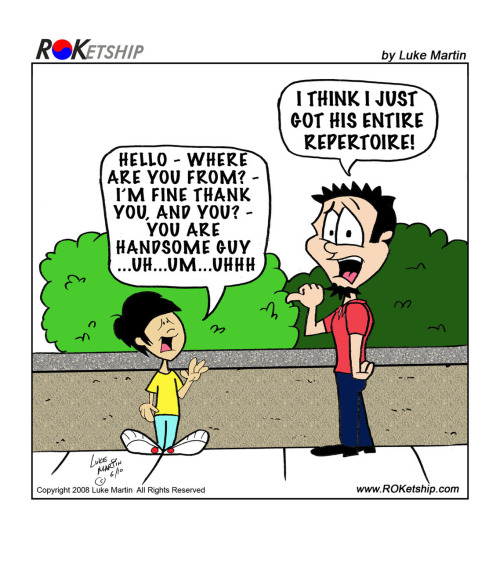


Many students learn English simply by memorizing phrases. Many of my students ramble off simply what they know even if it makes no sense. I've had some adults do it to me as well, and I try not to laugh as they say "Hi-where-are-you-from-nice-to-meet-you-I-am-happy-to-meet-you-are-you-from-America-I-am-from-Korea-have-a-nice-day." 
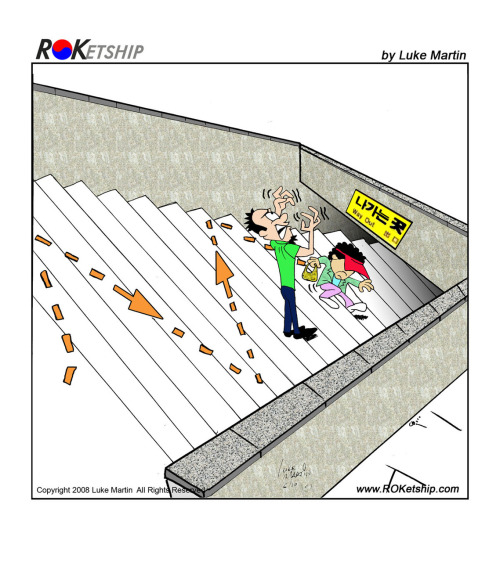


One of the things that annoys me the most is the rules of walking on the streets. It seems there is no respect for the standard system of walking the same directions as in which you drive. Old ladies (adjumma's) are particularly bad when it comes to this because they are usually "pushy" by Western standards, and get to where they want to go by any means necessary! I can't explain how many times I've been cut off by some old woman strolling along, only to stop right in front of me as I almost slam into her because she's not paying any attention to others around her. 


Customer service is a high priority for Korean businesses. In this highly competitive country with franchises on every corner, building customer relations is key if you want to keep your customers happy and returning. One bad experience will trickle down the grapevine and make your company look bad. I love the customer service to a certain degree. On one hand, the salespeople can be very pushy to make the sale - and even lie to you or exaggerate their products. Other times, it is great to get a nicely packaged or gift wrapped item with extra small bonus gifts thrown in - usually free of charge. When it gets ridiculous is when you go to the big department stores and you have 3 people welcoming you to the store, 2 people directing traffic in dancing style, and one lady taking a parking ticket out of the automatic ticket machine for you. That's too much. In the cartoon, the Westerner is only buying something small but getting a huge gift basket from Skin Food as a thank you for shopping there)
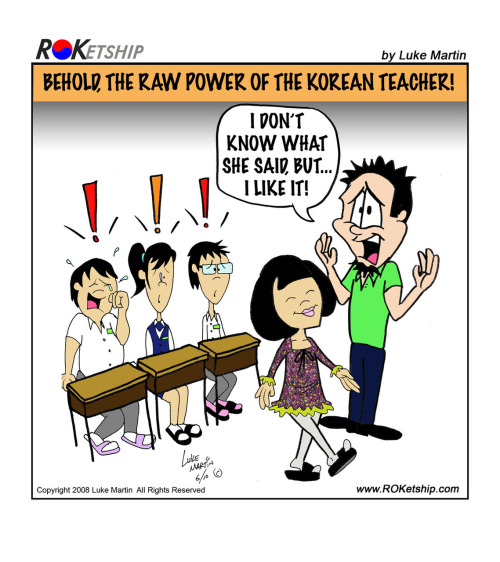
 
My co-teachers usually do not say or do much in my classes anymore, as I've gotten my classroom rules pretty much down with my students and they understand my consequences. Yet, there are times when I am having a rough class and all my tiny co-teachers need to do is yell a few words and maybe threaten to hit someone and the students go silent and apologize to me. 
Now that is power!

Monday, September 21, 2009

"Walk It Out"

One thing that has really annoyed me since I arrived in Korea is their sense (or lack thereof) of instinctual direction.

With such a large population crammed into a small space, there is always a little discomfort when navigating your way through crowds. In Seoul, you can be packed into subways during rush hour like sardines, and my biggest pet peeve so far - you have to walk with caution even when it's not crowded because people don't know how to walk on the right.


Walking down the street, up some stairs, or in a hallway shouldn't be a game of dodge-ball - but it seems to be. I find myself constantly juking left and right, slowing down and speeding up to pass people, and worst of all - facing an incoming crowd of people walking on MY side of the sidewalk.

In the West, we generally walk on the right hand side of everything - and mimic how we walk to how we drive. I makes perfect sense, it's human instinct, and because of this, the flow of pedestrian traffic works wonderfully. However, Koreans love to make life just a little bit annoying. An old law has had people walking on the left for years - (thanks in part to Imperial Japan when they occupied Korea).

http://www.koreatimes.co.kr/upload/news/070926_p03_traffic.jpg

That's not even the worst part. When I have to walk on the pedestrian bridge on my way to work, the traffic is intertwined with many people just dodging each other in a chaotic battle of chicken to see who will move out of the way first.

When I'm walking on the stairs at school, I have to dodge kids going up and down the right and left sides of the stairs. One of the gym teachers a couple weeks ago put up a few signs saying "Keep to the Right" in both Hangul and English (the kids still don't). But at least they move out of my way out of respect for their elders (or out of pure fear of the big white dude). 

To my surprise - and happiness - I got to read this lovely little article in the LA Times about how the SK Government is bringing about a much needed change with the "Keep Right" campaign.

I'm also going to post it below as I'm not sure if it will be available after a few days.


South Koreans do the 'right' thing

As part of a government campaign to get pedestrians to stop taking the left side, the directions of escalators and stairs in the capital have been switched. Surprises await those not paying attention.

Walking the 'right' way in Korea
Commuters negotiate a crowded subway station in Seoul. (Ju-min Park / Los Angeles Times)
 By John M. Glionna and Ju-min Park

Reporting from Seoul - Lee Young-soo sees a social revolution happening before his eyes: South Korea's fundamental shift to the right, a move that has many here fretting about a looming collision.

It's not politics they're talking about, but walking in public.

As he hurries through the chaotic pedestrian flow at a local subway station, Lee moves instinctively left to take the down escalator toward his train -- only to see the mass of commuters rising toward him.

Narrowly missing slamming into someone, he scurries over to the right side and joins the others moving down.

"For a while," says the 48-year-old, "this might be uncomfortable."

A new government campaign is bucking the "stay left" law in force here for decades, forcing pedestrians on escalators and moving walkways in the city's massive subway system to move to the right.

The direction of Lee's escalator was recently reversed, and in coming weeks, hundreds, if not thousands, more will follow as the plan is introduced to the rest of the nation.

Officials say the move makes perfect sense -- falling into line with international practice and increasing the pedestrian flow, presumably by cutting down on collisions. And because nearly 90% of South Koreans are right-handed and the country drives on the right, keeping left goes against instincts, they say.

"Our country is the one that started all the trouble by initially forcing people to walk in a certain direction," said Hwang Duk-soo, head of the National Movement of Keeping Right.

"In the past, when Koreans go abroad, they hit foreigners. And vice versa, foreigners come to Korea and bump into Koreans."

Hwang has become a bit of a philosopher when it comes to bodies in motion. He's done his research.

In 1921, during the Japanese occupation, South Korea required both pedestrians and cars to stay left -- following the custom that still exists throughout Japan. Then, in 1946, under the U.S. military administration after World War II, South Korea moved vehicles to the right but left pedestrians where they were.

Sociologists say the latest changeover won't be smooth.

"It could take a bit of trial and error since the custom that we have used is going to be thrown away," said Gihong Yi, a sociology professor at Hallym University. "There could be some repercussions. However, walking on the right has been proved good in a sense of human engineering."

Such elemental shifts have been going on elsewhere in Asia and the Pacific. This month, the island nation of Samoa switched from driving on the right. Contrary to official fears, chaos did not ensue.

At the Express Bus Terminal in Seoul, which made the switch with escalators and walkways before the program's official kickoff next month, some people are worried.

"It sounds good," said Jin Ho-jun, 68, a former banker. "However, I am worried because many elders who are used to the old way use subways so often."

Seoul transportation officials are gearing up for the official switch starting Oct. 1, when they will have hundreds of volunteers during congested rush hours at 163 subway stations citywide.

Many stations have already been papered with promotional posters showing a smiling, happy family and reading: "Keep to the right! You are beautiful for taking part."

The Korea Transport Institute expects that the move will eventually increase walking speed within the subway system and reduce pedestrian collisions by as much as 25%.

Officials say offenders against the new system will not face fines but will be encouraged to go with the flow.

To make the crossover run more smoothly, Koreans need to be patient, advocates say. "Critics should know that nothing is perfect. The one is just better than the other one," Hwang said.

Still, he can't hide the philosopher within him.

"Technically, no one should tell us to walk to the left or to the right," he said. "It is much easier to just go with instinct."

john.glionna@latimes.com

Park is in The Times' Seoul Bureau.

Visitors

free counters