Showing posts with label South Korea. Show all posts

Friday, June 25, 2010

"Give Peace a Chance"

 Parts taken from Boston.com

Remembering the Korean War, 60 years ago

"This Friday, June 25th, it will have been sixty years since the beginning of the Korean War in 1950. After decades of Japanese occupation, Korea was divided in two by Allied Forces at the end of World War II, with the south administered by the U.S. and the north by Soviet Russia. Deep divisions built over several years, leading to skirmishes and finally an invasion by North Korean troops on June 25th, 1950. The United Nations sent troops and support from 21 countries to support South Korea, primarily from the United States and Britain. The war lasted for three years, with large advances and retreats on both sides, and many casualties. Hundreds of thousands of civilians and soldiers were killed. The two Koreas are technically still at war since hostilities ended in a ceasefire, not a peace treaty in 1953. Though it is often referred to as "The Forgotten War", I hope this collection of photographs helps us to remember the events of 1950-53, those involved, and the legacy that still remains, sixty years later"

Here are some of my favorites:

Note: I've added some "after" pictures of how Korean 
has transformed so much in the last 60 years.

Then: Villages were being turned into rubble, homes decimated
families separated, and lives destroyed.
A U.S. Marine tank follows a line of prisoners of war down a village street. September 26, 1950. (U.S. Department of Defense/U.S. Marine Corps/S. Sgt. John Babyak, Jr.)
Now: My "village" of Sanbon on the outskirts of Seoul - full of families and prosperity.

Then:
Four LST's unload men and equipment on beach in Inchon on Sept. 15, 1950. (AP Photo)

Now: Inchon is a major international port and a main supply line to Seoul
http://commondatastorage.googleapis.com/static.panoramio.com/photos/original/4146224.jpg

Then: Taejon (Daejeon) was practically obliterated
General views of burned city of Taejon on Sept. 30, 1950. (AP Photo/Jim Pringle) 


Now: Daejeon is the 5th largest city in Korea and 
the center of transportation in South Korea

http://erec.hihome.com/ImportedFiles/erec-hot/daejeon,cityhall,dunsandong.jpg 

Trees stripped by artillery and aerial bombardment stand like match sticks in this air view of hill 931 on Oct. 22, 1950, one of the main peaks which dominated Heartbreak Ridge in Korea. The complex system of communist trenches and bunkers are visible. This hill was taken twice by U.N. forces, the last time on October 6 by elements of the 23rd U.S. Regiment and a French Battalion. (AP Photo/GS)

Now: The DMZ has stood in place for the past 60 years with minor skirmishes to remind the government's on both sides that they are still technically at war. North Korea remains a secretive and reclusive nation that is controlled by a repressive government. Food shortages are common, and the country has made little advancement besides building up it's military. South Korea has flourished into a thriving nation full of opportunities, technological advancement, and is major industrial player on the international stage.
http://images.travelpod.com/users/christosp/1.1215671160.mountains-of-north-korea.jpg

"If you look at a picture from the sky of the Korean Peninsula at night, South Korea is filled with lights and energy and vitality and a booming economy; North Korea is dark." - Donald Rumsfeld

http://www.australianclimatemadness.com/wp-content/uploads/2010/03/north_south_korea.jpg

Today: Korea's military is ever vigilant in regards to the North. Decades of mistrust and threats combined with assassination attempts, kidnappings, and espionage have kept the country divided. However, hope still remains that some day the two Korea's can one day become one. Time can only tell, but the longer it takes, the harder it will become.
 In this photo taken on Tuesday, June 15, 2010, a South Korean Marine looks at the North Korean side as he stands guard on Baengnyeong Island, South Korea, near the border with North Korea


Please make sure you take a look at the full article at boston.com. It is filled of astounding images (some disturbing.)

Tuesday, June 1, 2010

"Fan Death"

In the western world, "Fan Death" is roughly known only as an Italo Disco band based out of Vancouver.
However, to the average foreigner living in South Korea, it is a very, very serious epidemic. (insert sarcasm here)

Fan Death is a Korean urban legend that many Koreans take as fact. The myth is as follows:

"If you leave an electric fan running while you are sleeping in a room with the windows closed, you will suffocate and die."

I had heard of fan death well before I left for Korea and thought it too pointless to really blog about since almost every westerner who has a blog writes about this strange phenomena. But I feel like being unoriginal today.

Death via electric fan sounds rediculous to most people, so it is very strange that many educated, rational, Koreans swear it is true. So true, that all electric fans sold in Korea have timers on them so you do not accidently leave it on all night and kill yourself. And they even have warnings posted as well:

http://wiki.galbijim.com/images/6/6b/Fan_death.JPG

A simple search of Wikipedia cites many "explanations" into the phenomenon, but here are the basics of how fans could kill you. Try not to laugh...

1. An electric fan creates a vortex, which sucks the oxygen from the enclosed and sealed room and creates a partial vacuum inside. (sounds like a plot of an episode of Star Trek)

2. Electric fans chops up all the oxygen particles in the air leaving none to breathe. (My favorite explaination)

3. The fans electric motor uses up the oxygen in the room and creates fatal levels of carbon dioxide. (even though they don't use fuel like a candle)


4. If the fan is put directly in front of the face of the sleeping person, it will suck all the air away, preventing one from breathing. (I do this all the time in the summer and to my recollection have never died)

5. Fans contribute to hypothermia, or abnormally low body temperature.[2] As the metabolism slows down at night, one becomes more sensitive to temperature, and thus supposedly more prone to hypothermia. (Maybe.... if you are extremely old and feeble, and possibly using the fan in the middle of the winter with your windows open)

6. Fans contribute to prolonged asphyxiation due to environmental oxygen displacement or carbon dioxide intoxication. (A bunch of fancy scientific words that means nothing because it's a load of hooey)

7. Fans directly on the body deprives "skin-breathing," leading to suffocation. (Maybe we shouldn't wear clothing either because clothes deprive our skin of breathing)

https://blogger.googleusercontent.com/img/b/R29vZ2xl/AVvXsEg4B3Qdwo_Xc5sM0E_omh5nNzo-rqe_GyTVtS5dfj6B9juGo73pheONdNUjLMC9XaTkByH2Y8_KNycjzP8Fp2eBRRKsm-oGn11_nwvPJGJwQLMPGJ8AbbRvQd8i4fJBdneLmGt3j4crHQ/s400/Fan+Death.jpg

The government's take is:
The Korea Consumer Protection Board (KCPB), a South Korean government-funded public agency, issued a consumer safety alert in 2006 warning that "asphyxiation from electric fans and air conditioners" was among South Korea's five most common seasonal summer accidents or injuries, according to data they collected.[10] Also included among the five hazards were air conditioner explosions and sanitation issues, including food poisoning and opportunistic pathogens harbored in air conditioners. The KCPB actually published the following:
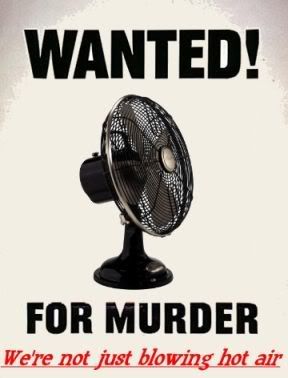
wanted_fan_murder.jpg image by matthew254
If bodies are exposed to electric fans or air conditioners for too long, it causes [the] bodies to lose water and [causes] hypothermia. If directly in contact with [air current from] a fan, this could lead to death from [an] increase of carbon dioxide saturation concentration [sic] and decrease of oxygen concentration. The risks are higher for the elderly and patients with respiratory problems. From 2003 [to] 2005, a total of 20 cases were reported through the CISS involving asphyxiations caused by leaving electric fans and air conditioners on while sleeping. To prevent asphyxiation, timers should be set, wind direction should be rotated and doors should be left open.
There are even cases of professionally published articles both stating fan death as truth and denoucing it as myth. I think I'm going to stick with it as a myth seeing how I have slept with the fan blowing directly on me with my windows closed on multiple occasions and have still lived to tell the tale.

 Now, where can I find a "I'm A Fan-Death Survivor" T-shirt, bracelt, and ribbon to wear and promote awareness....?

Perhaps it only effects Koreans?

Nope. Here's a video someone posted testing that theory:


A special thanks to Kelly O. R. for the suggestion to post this.
Happy Birthday to you as well!

Visitors

free counters