Showing posts with label Korean women. Show all posts

Tuesday, July 13, 2010

Rocketman - Part 3

As I've posted before (here and here), there is a excellent website called ROKetship, where a cartoonist named Luke Martin draws up a single pane comic about living and teaching in South Korea. He does some great work, and I figure I'll post some with some explanations of these hilarious observations:

It is not uncommon to see the elderly (the poor elderly) gathering up cardboard or wood from dumpsters or picking through the trash. I see this every morning on my way to work. The materials are recycled and traded in for cash - similar to how some states have bottle and can redemption programs back in the States. It's sad that a lot of the elderly have no pensions or retirement accounts, as they grew up in a time where the country was destroyed and have little more than an elementary school education. They work very hard and scrimp and save - I give these men and women a lot of respect.


Korean are relatively conservative in nature coming from a Confucian background, and more recently embracing a very strong Christian background. It is considered uncouth for a woman to show cleavage. There is even a term that means a woman looks like a "milking cow" if she shows too much chest. Western women, tend to show more however, and Koreans may view it as being inappropriate. Korean women do show a lot of leg though, and it is considered very sexy to show off their long legs - however, in my opinion some show off too much, that in the US it would be considered looking "slutty" or inappropriate. I love this panel for pointing it out! (note: The Korean girl is saying "ya-ha-da" which means "too sexy" or "loud!"


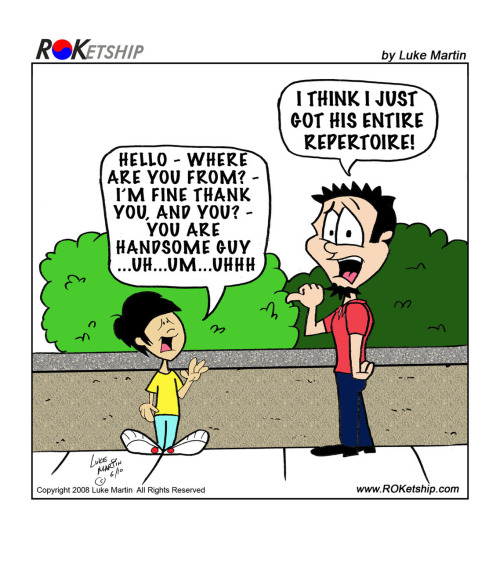
Many students learn English simply by memorizing phrases. Many of my students ramble off simply what they know even if it makes no sense. I've had some adults do it to me as well, and I try not to laugh as they say "Hi-where-are-you-from-nice-to-meet-you-I-am-happy-to-meet-you-are-you-from-America-I-am-from-Korea-have-a-nice-day." 


One of the things that annoys me the most is the rules of walking on the streets. It seems there is no respect for the standard system of walking the same directions as in which you drive. Old ladies (adjumma's) are particularly bad when it comes to this because they are usually "pushy" by Western standards, and get to where they want to go by any means necessary! I can't explain how many times I've been cut off by some old woman strolling along, only to stop right in front of me as I almost slam into her because she's not paying any attention to others around her. 


Customer service is a high priority for Korean businesses. In this highly competitive country with franchises on every corner, building customer relations is key if you want to keep your customers happy and returning. One bad experience will trickle down the grapevine and make your company look bad. I love the customer service to a certain degree. On one hand, the salespeople can be very pushy to make the sale - and even lie to you or exaggerate their products. Other times, it is great to get a nicely packaged or gift wrapped item with extra small bonus gifts thrown in - usually free of charge. When it gets ridiculous is when you go to the big department stores and you have 3 people welcoming you to the store, 2 people directing traffic in dancing style, and one lady taking a parking ticket out of the automatic ticket machine for you. That's too much. In the cartoon, the Westerner is only buying something small but getting a huge gift basket from Skin Food as a thank you for shopping there)

 
My co-teachers usually do not say or do much in my classes anymore, as I've gotten my classroom rules pretty much down with my students and they understand my consequences. Yet, there are times when I am having a rough class and all my tiny co-teachers need to do is yell a few words and maybe threaten to hit someone and the students go silent and apologize to me. 
Now that is power!

Tuesday, November 3, 2009

"A New York State of Mind"

Thanks to my friend Stella for sending me this NYTimes article. I learned a lot more about how different races are viewed here. Some of these "discrimination's" I have felt first hand as not being Korean. Although it helps that I am white versus Southeast Asian or Middle-eastern. I have noticed that ever since dating Hwayoung, I get more looks of disapproval from older men. Women and children on the other hand want to talk to me or think I'm cute -- can't argue with that!
 
 
The New York Times
 
South Koreans Struggle With Race


Jean Chung for the International Herald Tribune

Hahm Ji-seon and her friend, Bonogit Hussain, were riding a bus near Seoul when insults were hurled at them.


Published: November 1, 2009 
 
SEOUL — On the evening of July 10, Bonogit Hussain, a 29-year-old Indian man, and Hahn Ji-seon, a female Korean friend, were riding a bus near Seoul when a man in the back began hurling racial and sexist slurs at them.

The situation would be a familiar one to many Korean women who have dated or even — as in Ms. Hahn’s case — simply traveled in the company of a foreign man.
What was different this time, however, was that, once it was reported in the South Korean media, prosecutors sprang into action, charging the man they have identified only as a 31-year-old Mr. Park with contempt, the first time such charges had been applied to an alleged racist offense. Spurred by the case, which is pending in court, rival political parties in Parliament have begun drafting legislation that for the first time would provide a detailed definition of discrimination by race and ethnicity and impose criminal penalties.

For Mr. Hussain, subtle discrimination has been part of daily life for the two and half years he has lived here as a student and then research professor at Sungkonghoe University in Seoul. He says that, even in crowded subways, people tend not sit next to him. In June, he said, he fell asleep on a bus and when it reached the terminal, the driver woke him up by poking him in the thigh with his foot, an extremely offensive gesture in South Korea.

“Things got worse for me this time, because I was with a Korean woman,” Mr. Hussain said in an interview. “Whenever I’ve walked with Ms. Hahn or other Korean women, most of the time I felt hostilities, especially from middle-aged men.”


South Korea, a country where until recently people were taught to take pride in their nation’s “ethnic homogeneity” and where the words “skin color” and “peach” are synonymous, is struggling to embrace a new reality. In just the past seven years, the number of foreign residents has doubled, to 1.2 million, even as the country’s population of 48.7 million is expected to drop sharply in coming decades because of its low birth rate.

Many of the foreigners come here to toil at sea or on farms or in factories, providing cheap labor in jobs shunned by South Koreans. Southeast Asian women marry rural farmers who cannot find South Korean brides. People from English-speaking countries find jobs teaching English in a society obsessed with learning the language from native speakers.

For most South Koreans, globalization has largely meant increasing exports or going abroad to study. But now that it is also bringing an influx of foreigners into a society where 42 percent of respondents in a 2008 survey said they had never once spoken with a foreigner, South Koreans are learning to adjust — often uncomfortably.

In a report issued Oct. 21, Amnesty International criticized discrimination in South Korea against migrant workers, who mostly are from poor Asian countries, citing sexual abuse, racial slurs, inadequate safety training and the mandatory disclosure of H.I.V. status, a requirement not imposed on South Koreans in the same jobs. Citing local news media and rights advocates, it said that following last year’s financial downturn, “incidents of xenophobia are on the rise.”

Ms. Hahn said, “Even a friend of mine confided to me that when he sees a Korean woman walking with a foreign man, he feels as if his own mother betrayed him.”

In South Korea, a country repeatedly invaded and subjugated by its bigger neighbors, people’s racial outlooks have been colored by “pure-blood” nationalism as well as traditional patriarchal mores, said Seol Dong-hoon, a sociologist at Chonbuk National University.

Centuries ago, when Korean women who had been taken to China as war prizes and forced into sexual slavery managed to return home, their communities ostracized them as tainted. In the last century, Korean “comfort women,” who worked as sex slaves for the Japanese Imperial Army, faced a similar stigma. Later, women who sold sex to American G.I.’s in the years following the 1950-53 Korean War were despised even more. Their children were shunned as “twigi,” a term once reserved for animal hybrids, said Bae Gee-cheol, 53, whose mother was expelled from her family after she gave birth to him following her rape by an American soldier.

Even today, the North Korean authorities often force abortion on women who return home pregnant after going to China to find food, according to defectors and human rights groups.

“When I travel with my husband, we avoid buses and subways,” said Jung Hye-sil, 42, who married a Pakistani man in 1994. “They glance at me as if I have done something incredible. There is a tendency here to control women and who they can date or marry, in the name of the nation.”

For many Koreans, the first encounter with non-Asians came during the Korean War, when American troops fought on the South Korean side. That experience has complicated South Koreans’ racial perceptions, Mr. Seol said. Today, the mix of envy and loathing of the West, especially of white Americans, is apparent in daily life.

The government and media obsess over each new report from the Organization for Economic Cooperation and Development, to see how the country ranks against other developed economies. A hugely popular television program is “Chit Chat of Beautiful Ladies” — a show where young, attractive, mostly Caucasian women who are fluent in Korean discuss South Korea. Yet, when South Koreans refer to Americans in private conversations, they nearly always attach the same suffix as when they talk about the Japanese and Chinese, their historical masters: “nom,” which means “bastards.” Tammy Chu, 34, a Korean-born film director who was adopted by Americans and grew up in New York State, said she had been “scolded and yelled at” in Seoul subways for speaking in English and thus “not being Korean enough.” Then, she said, her applications for a job as an English teacher were rejected on the grounds that she was “not white enough.”

Ms. Hahn said that after the incident in the bus last July, her family was “turned upside down.” Her father and other relatives grilled her as to whether she was dating Mr. Hussain. But when a cousin recently married a German, “all my relatives envied her, as if her marriage was a boon to our family,” she said.

The Foreign Ministry supports an anti-discrimination law, said Kim Se-won, a ministry official. In 2007, the U.N. Committee on the Elimination of Racial Discrimination recommended that South Korea adopt such a law, deploring the widespread use of terms like “pure blood” and “mixed blood.” It urged public education to overcome the notion that South Korea was “ethnically homogenous,” which, it said, “no longer corresponds to the actual situation.”

But a recent forum to discuss proposed legislation against racial discrimination turned into a shouting match when several critics who had networked through the Internet showed up. They charged that such a law would only encourage even more migrant workers to come to South Korea, pushing native workers out of jobs and creating crime-infested slums. They also said it was too difficult to define what was racially or culturally offensive.

“Our ethnic homogeneity is a blessing,” said one of the critics, Lee Sung-bok, a bricklayer who said his job was threatened by migrant workers. “If they keep flooding in, who can guarantee our country won’t be torn apart by ethnic war as in Sri Lanka?”

Thursday, October 22, 2009

"Just A Girl"

I've noticed recently, that a handful of people have complained about their schools. I'm not positive about the reason but I think I've narrowed it down using my Sherlock Holmes detective style. (and yes, I do like to wear the hat).

http://www.cosmosmagazine.com/files/imagecache/feature/files/20080314_sherlock_holmes.jpg

Here are some of the most common complaints:
  • "My co-teachers hate me, and treat me badly."
  • "My students are rude to me or insult me."
  • "Other teachers in the school tell me I'm fat or should lose weight."
These people (who shall not be named) have one thing in common -- they are all women.

http://www.boredwithironing.co.uk/images/shock.jpg

I discussed this with a few of my teachers while at dinner the other night, and their answer shocked me.

"We don't like female foreign teachers because they are seen as weak or complain a lot about many things because they are too sensitive."

I think female teachers come into the job just as anyone else, but the second they walk in that school door they have already been stigmatized. Perhaps they don't live up to the expectations of what Western women are "supposed" to be like. Apparently in Korea this means all Western women look like Angelina Jolie - and there is a big disappointment when they face reality.


http://www.visualpharm.com/wallpaper/angelina_jolie_wallpaper_1024x768.jpg


As for the students being rude or insulting female teachers, again, I am surprised. My students are nothing but respectful to me. Almost all of them say I am either handsome (I don't think I am), or that I look like I've lost a lot of weight (I haven't -- ok, maybe a few pounds), but they never -- NEVER -- insult me. Then again, I'm not a woman.


If sensitivity is an issue, I could understand why Western women would feel they are being insulted. The English ability among the students (and most native teachers) is relatively low. Most of the time they are simply translating from Korean to English - and it can be very blunt. For example, I showed a picture of a crutches to my students for a lesson on hospitals. They translated it into "wooden leg". Part of the reason we're teaching here is to give these students a larger vocabulary and to teach them how to say things properly. If someone calls you fat, you should teach them the word "impolite" and then teach them how to say it a nicer way. An overly sensitive person will not survive here if they are not aware of the cultural and language barrier that most definitely exists.

engrish funny refusal pets

On the flip side, I get into trouble when I say the words "crazy" or "cute". If I say to a Korean "you are crazy" in a jesting way, they sometimes take it as an insult, as if I were saying they actually were psychotic. If I say a beautiful woman is cute, they think I'm calling them cute as in a dog or a baby - and not attractive.

If you are planning on coming to Korea, I recommend you do some research beforehand about the culture. It is a society based on respect, and sadly, they respect men more than women. They also sadly respect Caucasian over being Black, Latino, Middle Eastern, and Pacific Islander. (and Korean above all others). Most of the communities with those immigrants are seen as the dangerous places to go. Like in most cultures - what you don't understand is scary to you.

As for the women out there having a tough time - good luck! I wish I could change how cultures view gender, but all I can give you for advice is to try and gain respect in the classroom and try not to take offense.


I Love Ajumas
Ajuma means "old married lady"

Visitors

free counters