Showing posts with label Northern Limit Line. Show all posts

Wednesday, November 24, 2010

"Bombshell"

Here we go again....


North Korea has once again attacked South Korea (this time there is no dispute like the Cheonan incident last March) {here is my post about it}. This incident also took place near the NLL (Northern Limit Line) on the island of Yeonpyeong-do.

US, S.Korea to coordinate response to N.Korea ...

Basically what happened was that the ROK forces were conducting military exercises in the area (a common occurance) - and were test firing artillery aiming south and southeast. The DPRK sent a letter demanding a stop to the exercises (another common occurance), of which the ROK forces ignored. North Korea then launched artillery into the South striking Yeonpyeong-do which is inhabited by some civilians and a large South Korean military garrison. The attack killed at least 2 ROK Marines, injured about 12-18 others including some civilians. It also set fire to approximately 60-70 homes on the island.

North Korean artillery pounds S.Korean island


The South Korean forces fired back and this went on for about an hour or so begining about 2:30pm yesterday. Both sides eventually stopped and people were evacuated from the island.

US, S.Korea to coordinate response to N.Korea ...


US, S.Korea to coordinate response to N.Korea ...

The local reactions here were not that noticeable, but after talking with people they showed their outrage and a little fear of war. There were people crowded around the TV's downtown as people watched and listened to the news, but there were no protests anything out of the ordinary that I witnessed.

South Korea isn't taking this incident lightly as the military and police have been put on crisis alert in case of any further agression. President Lee Myung-Bak has also called for “multiple-fold retaliation” if the North provokes more. But as for now, things are relatively calm but could blow up at any minute.

Lee Myung-bak


The U.S. Media loves a good story, and is a little more dramatic, stating we're on the "Brink of War" (even though the 2 countries have technically been at war since the cease-fire was signed in 1953)


Sean Hannity (a opinion commentator, not journalist) and Karl Rove turn the story into "dozens of citizens" injured, and follows Fox News over-dramatic "reporting"  of the events and cites Obama's lack of response. Why the push for war? Ratings? Don't these people realize if a war was to break out thousands, if not millions of people would die, be injured, and their lives would ever be altered?
 And while we're at it, can we just promote Karl Rove's book...


Netizens and other commentators on blogs are a little over the top, stating this is the start of WW3, Nuke China, and how the "socialist Obama liberals have no guts to do what's right and nuke the North" - yeah, try not to read that garbage.

If you want a better perspective, stay away from the US Media and focus on BBC news, or the Korean media (links located to the right).

For a good over-all view, here is a decent article I found on Yahoo:


Tensions on the Korean peninsula: 
What you need to know
By Zachary Roth


Tensions are near the boiling point on the Korean peninsula after North Korea shelled a South Korean island, killing two South Korean soldiers. What's behind this latest spike in hostilities between the longtime adversaries, and just how concerned should we be -- especially since we have 25,000 military personnel stationed in South Korea?  Here's what you need to know.

What happened, exactly?

Early Tuesday, North Korea fired artillery shells at the South Korean island of Yeonpyeong, which sits off the disputed maritime border between the two countries. The attack killed two South Korean marines and wounded 18 soldiers and civilians.  It prompted an exchange of fire between the two sides, involving around 175 artillery shells and lasting about an hour.
The North accused South Korea of having started the exchange by firing shells inside North Korean territory during a set of South Korean military exercises that the North called "war maneuvers."  The South denies that charge, saying that its soldiers were merely conducting military drills and that no shots fell in North Korean territory.
The North Korean attack was the first on a civilian area of South Korea since the Korean War.

Why did this happen now?
Tensions have been running high since March, when a South Korean naval vessel in the same area was sunk, killing 46 sailors. Seoul blamed a North Korean torpedo attack, though the North has denied involvement. Then earlier this month, the South Korean navy fired warning shots at a North Korean fishing boat after the craft strayed across the border. The North Korean boat retreated.

Some analysts have linked Tuesday's action by the North to the impoverished nation's need for food. The Obama administration has refused to remove sanctions against the North, imposed in response to its nuclear program. "They see that they can't pressure Washington, so they've taken South Korea hostage again," Choi Jin-wook, a senior researcher with the South Korean Institute for National Unification, told the New York Times.  "They're in a desperate situation, and they want food immediately, not next year."
Does this have anything to do with North Korea's leadership situation?
Kim Jong Il, the North's ailing and reclusive leader, is believed to be  gradually shifting power over to his son, Kim Jong Un, who in September was promoted to the rank of four-star general.

Some analysts believe the transition has made North Korea eager to demonstrate its military power.  Kim Jong Il famously employed an aggressive "military first" approach to politics, and spoke of turning the North Korean army into a "pillar of the revolution."  The regime may now want to show the world that the same military-first policies will prevail under his successor. "The son's power base is derived from the military, and the power of [the] military is greater than ever," Cheong Seong-Chang, a fellow at the Seoul-based Sejong Institute, told Time magazine.

How has the world reacted?
The United States, Britain and Japan have condemned the North Korean attack, with America calling on the North to "halt its belligerent action." China said it was "concerned," while Russia has urged restraint and a peaceful solution to the crisis.

What's the U.S. role in all this?
The United States wants North Korea to resume the six-party talks on the country's nuclear program. The talks, which also include Russia, China, Japan in addition to America and the two Koreas, were launched in 2003, after North Korea opted out of the Nuclear Nonproliferation Treaty. The talks' aim is to arrive at a peaceful diplomatic agreement to contain the North's nuclear capacity -- but the talks have been in limbo since 2008, and earlier this week, an American scientist revealed that he had been shown a sophisticated North Korean nuclear enrichment facility, throwing the resumption of the talks into further doubt. 

Today's incident adds another obstacle, experts say.
The revelation of the uranium facility and Tuesday's attack on South Korea may both be expressions of the North's concern that the Obama administration and its allies are unlikely to offer concessions such as the easing of sanctions. "I think they realize they can't expect anything from Washington or Seoul for several months, so I think they made the provocation," Choi Jin-wook, senior researcher at the Korea Institute of National Unification, told CNN. 

How scared should we be?
South Korea has placed its military on "crisis status," and Prime Minister Lee Myung-bak has reportedly ordered strikes on North Korea's missile base if the North makes any "indication of further provocation." It appears unlikely, though not impossible, that further military action will result. 

South Korea does not have an active nuclear weapons program. North Korea is believed already to have eight to 12 nuclear bombs. But nuclear issues aside, any military conflict between the countries could badly destabilize the region, especially if the North Korean government were to collapse -- an outcome that some South Koreans fear could lead to a Chinese takeover.

Thursday, May 20, 2010

"Evidence"

Tension is mounting slightly these past few days due to the new reports coming out that North Korea is being held responsible for the sinking of the ROKS Cheonan on March 26th. (see my previous post here).

http://www1.cw56.com/images/news_articles/389x205/061003_north_korea_south_ko.jpg

According to the Joongang Daily there was evidence of a North Korean serial number found on a torpedo fragment:

“A North Korean-manufactured torpedo that carried a 250-kologram [551-pound] warhead is confirmed to be responsible for the explosion."

The decisive evidence was torpedo fragments collected from the sinking site. The propeller of the torpedo was recently recovered and a North Korean marking was on it, the ministry said. The marking read “1 Beon” using the Arabic numeral and the Korean letter that means number.

The recovered components were identical to the designs of a North Korean sonar-tracking torpedo depicted on an arms export catalog of the communist regime.

The experts also based their conclusion on analysis of evidence collected from the site of the sinking, the hull of the salvaged ship, postmortem examinations of the dead sailors, seismic waves, simulation of underwater explosions and currents near the sinking site, the ministry said.
 Here is a decent overview from CNN:


The DPRK has denied the allegations:
North Korea immediately challenged the report and threatened to go to war if the South retaliates or imposes sanctions. The North's highest power organ, the National Defense Commission, chaired by leader Kim Jong-il, also said it intends to send a verification team to South Korea to disprove the probe's findings.
Last week, Kim Myong Chol, who is often called an "unofficial" spokesman of Kim Jong-il and North Korea, wrote the following as it was posted on the Asia Times Online website:

http://upload.wikimedia.org/wikipedia/commons/thumb/e/ea/KimMyongChol.jpg/200px-KimMyongChol.jpg
Mission impossible
There are four important points that make it clear that a North Korean submarine did not sink the South Korean corvette.

Fact 1.North Korean submarines are not stealthy enough to penetrate heavily guarded South Korean waters at night and remain undetected by the highly touted anti-submarine warfare units of the American and South Korean forces. A North Korean submarine would be unable to outmaneuver an awesome array of high-tech Aegis warships, identify the corvette Cheonan and then slice it in two with a torpedo before escaping unscathed, leaving no trace of its identity.

Fact 2. The sinking took place not in North Korean waters but well inside tightly guarded South Korean waters, where a slow-moving North Korean submarine would have great difficulty operating covertly and safely, unless it was equipped with AIP (air-independent propulsion) technology.

Fact 2: The disaster took place precisely in the waters where what the Pentagon has called "one of the world's largest simulated exercises" was underway. This war exercise, known as "Key Resolve/Foal Eagle" did not end on March 18 as was reported but actually ran from March 18 to April 30.

Fact 3: The Key Resolve/Foal Eagle exercise on the West Sea near the Northern Limit Line (NLL) was aimed at keeping a more watchful eye on North Korea as well as training for the destruction of weapons of mass destruction in the North. It involved scores of shiny, ultra-modern US and South Korean warships equipped with the latest technology.

The incident has become a huge issue, and is gaining momentum as the new evidence agreed upon by the multi-national team of US, Australian, Swedish, and South Korean experts that the North is the culprit and that the serial number discovered is the "smoking gun".

Relations are also being strained due to Kim Jong Il's recent trip to China where he was publicly embraced as China showed it still supports the communist dictatorship as it's friendly neighbor.  The trip had been anticipated for quite some time, and was made in early May shortly after the Cheonan's sinking, perhaps as a way to strengthen ties and support if it came to light that the North was involved.

President Obama has pledged his support to the South, as the two countries are very close. Obama phoned President Lee Myung-Bak. "The South Korean presidential office said Obama supported South Korea’s response to the incident and said he “fully trusts” the investigation conducted by a team of international experts."

“President Lee and President Obama agreed that North Korea must honor its international obligations under United Nations Security Council Resolution 1874 and its commitment to dismantle its nuclear weapons programs,” a statement by the Blue House read. “At the same time, the leaders said North Korea must stop its belligerent course of action and that they will strengthen their alliance.”

What's next for North Korea? Another CNN report:


As for the daily lives of the people of South Korea? It feels as though nobody is worried. This has been the manner I've witnessed all year. The North constantly has threatened war for decades that it has become second nature to hear it. People go about their daily lives and don't pay much attention to the posturing of the North, its propaganda.


Next post: Sports Day!

Thursday, April 29, 2010

"Hymn to the Sea"


 http://2.bp.blogspot.com/_aCTVdAcm_uk/SJsD5pO6aLI/AAAAAAAAAWI/EHJ17oFnHSo/s320/290px-South_korea_flag_large.png
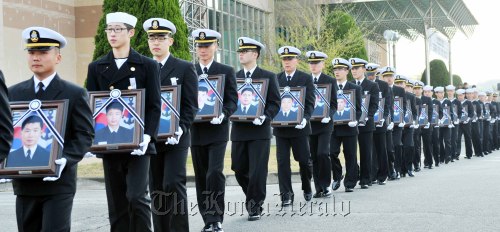
After a five day mourning period, the 46 lost sailors of the Naval frigate Cheonan were laid to rest today at the Daejeon National Cemetery.


Map
South Korea's ROKS Cheonan (PCC-772) was sunk on March 26th, 2010 due to presently unknown reasons. However, at this point in time, it is believed to be an external explosion due to a torpedo or even a mine. The ship was on patrol on the hotly disputed Northern limit lines in the Yellow Sea. Since the area has been under dispute, and there is speculation of the North Korea's (the DPRK) involvement, as there have been multiple incidents over the last 10 years. In May of 2009 the "North stated that it 'will not guarantee the legal status' of five South Korean islands near the disputed inter-Korean border in the Yellow Sea." Specifically, claims have been made that this may be retaliation for the incident back in November of 2009 which caused a North Korean vessel to sustain damage. The DPRK's vessel allegedly was on routine patrol, crossed the Northern Limit Line, and was chased back over the line by the South. (Apparently a flexing of muscles preceding President Obama's visit at the time).
Also, rumors have been abound that the DPRK is not denying the incident, and even bragging about it, as it strengthens it's military image as a force to be reckoned with and instills some fear in the much more prosperous South. Even claims that "human torpedoes" were used to sink the Cheonan. Again, this is all rumors and isn't backed up by any facts except for reports from what I personally consider unreliable newspapers.


The reasoning for the torpedo theory is because the ship was recovered from the sea floor in 2 parts. The metal from the ship was folded inwards, making an internal explosion an impossibility.

https://blogger.googleusercontent.com/img/b/R29vZ2xl/AVvXsEg_M-1_DSLyVDpkhYoWLY9uCj3ekGSIhajd-y28J3oLVag2-Yi4wXFqVx1w5l9oBZNXiBC23sE9BJ3CQpe5o17mvNnYJkwvUGwH4AY0lMUZROUx9BE6JGbVkIa70i1wv3FgCddEm5oprPQ/s1600/cheonan.jpg

Before
After
A section of the Cheonan is lifted on 24 April 2010

The BBC also reported the following:

After an initial examination the following observations and explanations have been announced to the public.
  • The skin of the ship was bent inwards, pointing to an external rather than an internal explosion, a conclusion given further weight by the fact that the ship's weapons storage area is intact
  • There are no signs of scraping, or of a collision, ruling out the possibility that the ship ran aground
  • There is no evidence of soot or melting on the skin of the ship, suggesting that the external explosion took place some distance away from the hull

The sinking of the Cheonan is indeed tragic and heartbreaking for South Koreans. 46 young sailors have died, not including a naval rescue diver who died during the week-long salvage/rescue attempt. Of the 46 dead, "thirty-eight were found in the stern, one in the funnel of the stern, and the remaining one in the gyrocompass room in the bow that was salvaged on Saturday. The other six may have been thrown off the ship in the explosion or swept away by tides."

This incident also has international complications. If the DPRK is proven to be at fault, how should the South react? Further military escalation would only worsen relations. The ROK and USA are two countries who do not want to see escalation. Seoul lies only a short way from the DMZ and is easily in striking distance and an all out war would cost millions of lives - quite possibly my own! Although, the case for that is relatively slim. If the North full-out attacked, it would mean the end of their regime as they would be driven back at a high cost of lives on both sides. If for some reason the DPRK took over the South, reunification would have no hope, and resistance would be fierce. The DPRK seems itching for the South to attack first. Maybe as to not be seen as the aggressor in international light, or maybe because it has realized that it is a dying country with food shortages and economic difficulties among other issues..

Personally, I suspect that the incident to basically blow over but never be forgotten. Yet another strain on an already tense situation.


Visitors

free counters